Monday, 11 April 2011

Influences and Ideas

Ideas we considered; The first was similar to what we are going with but we were thinking of animating it in a paper cut out 3D space. We agreed that this set up would take too long to build as it would have to be large enough for good camera movement. The Calligrapher was the main inspiration for this.


The looking at sand animation example from Dawn Tuffry and then looking at music and animation syncronized i thought to bring the two together. Billy then suggested animating art styles on flat 2D paper format which we agreed would look good but drawing all the movements did not seem practical so we combined the idea of layering paper and sand animation together where they may function as background and foreground.

Applying what we have learnt into our animation:

In the idea of animating several art styles gives us the opportunity to look at some of the ideas we have studied in class and applying these ideas appropriately to the art style. Such as Metamorphism. This may be appropriate to apply to the cave paintings as they take on a slightly absracted form which is different for each style of cavepainting and we can show this through morphing the creature into a different cave painting style of the same creature.

Great illustrative axmaple of Metamorphosis.


For the Egyptian style we could consider the ideas presented in the reanimating on screen space artical such as.. *************
The example the artical talks about is an amazing example of using space. The transitions are creative and unusual creating a strong level of interest which is what we hope to achieve.

Applying the idea of space and perspective to the egyptian style would create such a contrast to the strict flatness of the style. I think it would reallt emphasize the idea of bringing art to life. Especially if we consider starting the style flat and strict then animating the onscreen space to bring it to life and then transition into the next art style.


This animation is a good example of how we might explore animating several art works into one frame as silhouette .

Examples Soundtracks

Here are some samples soundtracks that we are looking into for our final animation. We are looking into traditional sounds, native to the same culture that we are exploring.

Prehistoric music
Prehistoric music (previously called primitive music) is a term in the history of music for all music produced in preliterate cultures (prehistory), beginning somewhere in very late geological history. Prehistoric music is followed by ancient music in most of Europe (1500 BCE) and later musics in subsequent European-influenced areas, but still exists in isolated areas.Prehistoric music thus technically includes all of the world's music that has existed before the advent of any currently-extant historical sources concerning that music, for example, traditional Native American music of preliterate tribes and Australian Aboriginal music. However, it is more common to refer to the "prehistoric" music of non-European continents – especially that which still survives – as folk, indigenous or traditional music.

From Wikipedia, the free encyclopedia


Egyptian Music
The music of Egypt has been an integral part of Egyptian culture since ancient times. The ancient Egyptians credited one of their Gods Thoth with the invention of music, which Osiris in turn used as part of his effort to civilize the world. The earliest material and representational evidence of Egyptian musical instruments dates to the Predynastic period, but the evidence is more securely attested in the Old Kingdom when harps, flutes and double clarinets were played. Percussion instruments, lyres and lutes were added to orchestras by the Middle Kingdom. Cymbals frequently accompanied music and dance, much as they still do in Egypt today. Egyptian folk music, including the traditional Sufi dhikr rituals, are the closest contemporary music genre to ancient Egyptian music, having preserved many of its features, rhythms and instruments.

From Wikipedia, the free encyclopedia


Japanese Music
Traditional Japanese music has no specific beat, and is calm. The music is improvised most of the time. In 1873, a British traveler claimed that Japanese music, "exasperate[s] beyond all endurance the European breast."

From Wikipedia, the free encyclopedia


European Music


Sunday, 10 April 2011

Introduction

For this proposal  we are looking to bring to life some classic art works covering various image genres such as Cave Art, Egyptian, Japanese, Art Nouveau and Classic European art works. Focusing on famous pieces which our audience is most likely to have a connection with.

We plan to explore the concepts we've learnt such as silhouette conceptual/ experimental animation as well as combining two different animation methods together as one piece, for example sand and paper animation. Using illustrative drawings or painting on paper to express the style in the background then using the sand to give movement and life to the illustrations.


Research
Image Genre

In this section we are looking at different areas of art history.

1. Cave Paintings
Firsty looking at some cave  paintings specifically looking at works dating to prehistoric times.

    Aurochs
   
    Altamira

The most common themes in cave paintings are large wild animals, such as bison, horses, aurochs, and deer, and tracings of human hands as well as abstract patterns, called finger flutings. Drawings of humans were rare and are usually schematic rather than the more naturalistic animal subjects. One probable explanation for this may be that realistically painting the human form was "forbidden by a powerful religious taboo." Cave art may have begun in the Aurignacian period (Hohle Fels, Germany), but reached its apogee in the late Magdalenian (Lascaux, France).

Many of the paintings were drawn with red and yellow ochre, hematite, manganese oxide and charcoal. Sometimes the silhouette of the animal was incised in the rock first

The shapes and textures shown in the examples above would be interestingly reproduced through sand on glass giving different gradients through the density of sand applied also holding that rough grainy quality of the paintings. These images would translate well for the use of negative space in sand animation. The simplicity and style of the images would enable easy manipulation of the image for animating movement while maintaining the style and image genre.

2. Egyptian Art
Secondly looking at Egyptian art as it is so distinct and recognisable in is strict form and consistent style.


 http://www.animhut.com/articles/design-history-egyptian-art-episode-4/


The art in Egyptian style was very strict. People were drawn front on while the heads were drawn in profile. Nature, animals and slaves were drawn more naturally with more freedom. There is never any attempt at perspective or spacial illusion. The colours are warm and each variation of colour served a symbolic purpose for example men's skin was painted red where women were painted yellow. The art works only ever showed vibrant youth and often illustrated their respect for death.

Exploring this art style in sand animation would bring emphasis on the consistent shapes and forms within this style. Giving such still flat images movement would be quite interesting as the restrictions in this art form would require creative and interesting transitions and movement.

3. Japanese Art
Japanese art shows a strong sense of culture through their art style. Some styles vary having a more organic feel and other work created through wood press has a more specific flat yet still organic touch.

    Fujinraijin


    http://en.wikipedia.org/wiki/File:Fujinraijin-tawaraya.jpg

   Hiroshige Atake


There is a strong use of positive and negative space to illustrate the shapes in these images. Most of these images appear very flat with some playing on the illusion of perspective or depth. These images have a lot of movement and emotion which would translate well into sand animation. Simple colours, limited gradients as well as large amounts of empty space would be key things to consider when animating to ensure the style is consistent and recognizable.

4. Art Nouveau
Art Nouveau is European craftsmanship at its peak. Art Nouveau is an style/area in art history consisting of more organic flowing forms. This was reflected through furniture design, architecture, and poster design. The effort and quality of work in this area is of such a high standard. The organic forms in this area show this.

Art Nouveau emerges realistic art style with flat colour and organic abstractions from the Japanese art. The art style is highly decorative and all these aspects should be portrayed in the animation to really emphasize the beauty and organic nature of Art Nouveau.

Concepts

In this process I will demonstrate some of the ideas we are considering for further development. Ideas needing to consider are mainly:
  • What parts of the illustrations will move?
  • How will each piece move according to the style and emotion of  the art piece?
  • What time frames are we giving to each image genre and how will they transition into each other?
  • What lighting/colour would we apply?

A lot of these ideas would be solved through story boarding and production itself.

As this part of the process is about generating ideas it would be greatly appreciated if we could have some feedback. Any ideas, considerations or questions would be appreciated as it would strengthen our concept and developments.

Cave Paintings

Looking to animate this image: 


Dividing the illustration into background and foreground:


Paper: (background)
Using translucent paper to illustrate the background textures.

Sand: (foreground)
Using the sand to animate the movements and transitions.

Concept: Animal enters the frame while the background is still to give the idea that the illustrations are moving over the rocks / texture.


Here is a small story board idea where the camera zooms out to reveal the art origonal art piece which has been animated.

The transition could start once the art piece is revealed or the story could refocus on the bull and morph its shape into another bull from a different cave painting style. This would be good to illustrate the difference in detail and to explore the idea of metamorphosis.


 Through the transition of metamorphosis gradients and detail will be introduces as we illustrate the second piece showing the textual qualities of sand animation.

Transition Ideas:

Possibly for the transition we could have the sand blowing away the foreground to imply the passing of time as if the image has been eroded away.


For the Background transition we could use the lights and camera to over expose the background allowing the details to disappear and a new background to fade-in replace it.

Another idea is to slightly soften the background and start the foreground animation for the Egyptian art piece and the background texture may be similar.

Egyptian Art

The beauty of sand animation is how one scene transitions into another... The last shot of the previous scene will depict the transition in this case. Bellow I have illustrated how I've used the transition described above to isolate the bull's eye and then again morphing the eye into the recognizable Egyptian symbol as well as manipulating onscreen space as we enlarge and rotate the eye.


Once the Eye is drawn the camera would zoom out revealing the rest of the image while at the same time parts of the image are drawn in and animated such as the eye blinking and the hair and crown extending.


Japanese Art

Here we are looking at this resource image to use in our animation:


Dividing background and foreground elements:

 For this concept we would divide the illustration like this. Adding an extra layer above to manipulate the rain using sand. For the movement animation the characters could be walking along the bridge as the cloud above darkens and swells eventually the rain will start pouring and the people will run along eventually leaving the page.

Transitional concept:


Recommended Setup

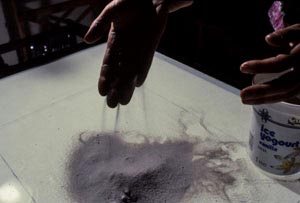
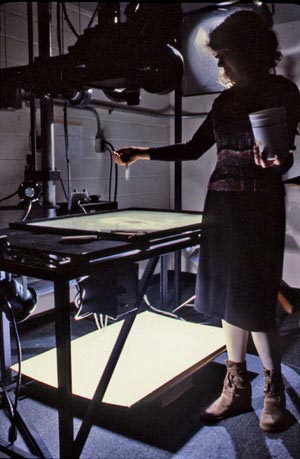
Recommended set-up for sand animation from renowned filmmaker and animator, Caroline Leaf .

Pour beach sand onto a white glass surface lit evenly from below.

sand 1

In a dark room.

sand 2

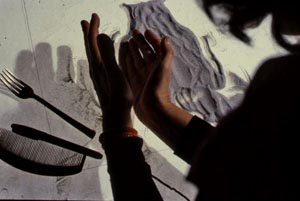
Using your fingers, or whatever tools are at hand, draw in the sand.

sand 3

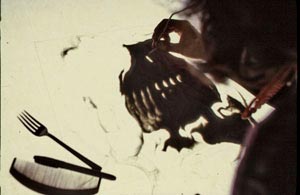
The opaque sand blocks light from below. . .

sand 5

. . . and creates dark shapes.

Source: http://www.carolineleaf.com/howtomake.html

Influences & Inspiration

 Caveman.
http://www.vimeo.com/7545670

Transitions.
Actions would come to a complete stop before the next action began.
Use of camre to introduce new elements.
Texture, colours

Exploring on screen space.